In today’s app ecosystem, monetization goes beyond traditional ads and subscriptions. Developers are increasingly turning to monetization SDKs like Infatica SDK to generate revenue while maintaining a seamless user experience. However, integrating a monetization SDK requires careful attention to privacy, security, and app-store compliance. Let’s see how monetization SDKs like Infatica SDK balance revenue generation with rigorous ethical standards, certifications, and transparent user consent to ensure fully compliant monetization.
How Infatica SDK Monetization Works (High-Level Overview)
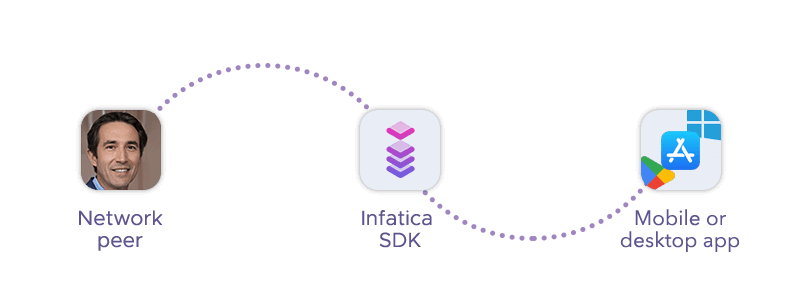
Infatica SDK offers developers a simple, low-maintenance way to generate passive revenue by connecting their users to Infatica’s peer-to-business (P2B) network. Instead of relying on intrusive ads or paid subscriptions, the SDK enables your app to earn money each time a user’s device becomes an active, verified participant in the network.
Once integrated into your Windows, Android, iOS, macOS, or Smart TV app, the SDK securely links a user’s IP address to Infatica’s infrastructure. Businesses and research organizations then use these residential connections for ethical, strictly regulated purposes – such as indexing websites for price comparison tools, enabling SEO experiments, monitoring brand presence, or conducting academic research. All activity is tightly controlled, pre-approved, and monitored to ensure that users remain safe and that their rights are fully respected.
For developers, the model is both straightforward and rewarding: Infatica pays up to $0.60 per active user per month, allowing you to earn meaningful passive income – even when users aren’t actively using your app. Because the SDK is lightweight and does not collect personal data, it preserves performance and user trust. And since users often prefer ad-free or low-distraction environments, offering participation in the Infatica network can significantly boost satisfaction, loyalty, and retention.
Consent-Driven Design: How Infatica Ensures User Permission
User consent is a central pillar of Infatica SDK’s compliance model. Because the SDK enables users’ network resources to participate in the peer-to-business (P2B) network, Infatica ensures that every participant clearly understands what this entails – and actively agrees to it. This approach aligns with privacy regulations, consumer-protection standards, and app-store policies across all major platforms.
Infatica SDK is engineered so that no participation occurs without the user’s knowledge and consent. Developers are required to provide transparent, prominent disclosures inside their app – typically in the End User License Agreement (EULA) or a dedicated consent screen – explaining how the user’s IP address will be used within the P2B network. Infatica provides guidance and sample language to ensure that these disclosures are accurate, compliant, and easy for users to understand.
This consent-based model also aligns with Google Play, App Store, and Windows Store requirements. For example, app developers are not required to declare IP addresses as “shared data” when:
- the transfer occurs after a user-initiated action, and
- the sharing is clearly disclosed and consented to within the app.
Infatica’s integration process is built around these principles. Part of onboarding includes verifying that the app’s disclosures and user-consent flow are implemented correctly before the app goes live. This ensures that every user knowingly participates and that developers remain fully compliant during app-store reviews.
Privacy and Data Protection: How Infatica Avoids Collecting Personal Data
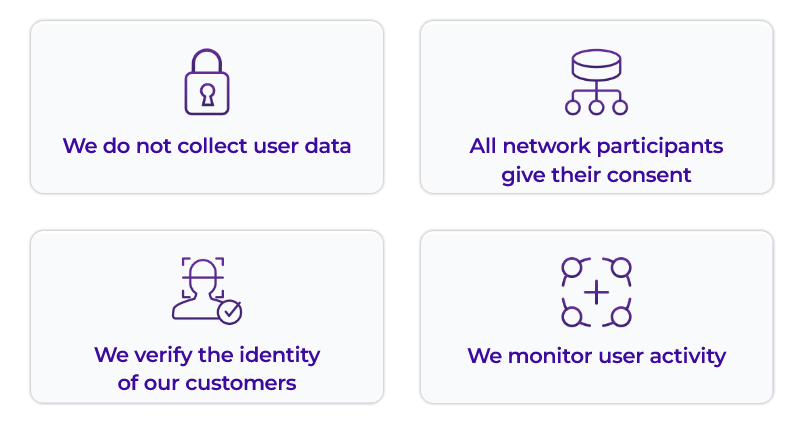
Privacy is one of the strongest differentiators of the Infatica SDK. Unlike many monetization tools that rely on user profiling, behavioral analytics, or data harvesting, Infatica’s model is deliberately designed to function without collecting, storing, or processing personal data. This architecture ensures that developers can monetize their apps while fully respecting user rights and maintaining regulatory compliance.
At its core, the SDK uses only what is strictly necessary: a user’s IP address, which is temporarily used to establish a secure connection to Infatica’s P2B network. No browsing activity, device identifiers, contact information, or behavioral metrics are ever collected. The SDK does not track, fingerprint, profile, or log personal usage patterns. This minimalistic data approach reduces risk, simplifies disclosure requirements, and aligns with GDPR expectations of data minimization and purpose limitation.
To protect users further, all network participation is pre-approved, monitored, and ethically restricted. Infatica enforces strict rules to ensure that customer activity through the network never involves scraping personal accounts, accessing private information, or interacting with sensitive platforms. Every request is vetted, controlled, and continuously monitored to ensure it complies with Infatica’s ethical code and global privacy standards.
Meeting Google Play, App Store & Windows Store Requirements

For any monetization SDK, app-store compliance is just as important as legal and privacy compliance – and Infatica SDK is designed to meet the expectations of all major distribution platforms, including Google Play, Apple’s App Store, and the Microsoft Store. Each of these platforms has strict rules around transparency, user consent, and data usage, especially when network resources or device-level permissions are involved. Infatica’s integration guidelines were created to help developers pass reviews smoothly without risking rejections or policy violations.
A key advantage of Infatica SDK is that it does not collect personal data, nor does it access unnecessary device information. This dramatically simplifies compliance. In many cases, developers do not need to declare IP address sharing in the Google Play Data Safety section because:
- the data transfer occurs after a user-initiated action, and
- the sharing is prominently disclosed in the app, with the app requesting and receiving explicit user consent.
This aligns with the platform’s own guidelines, which allow these transfers without requiring a “data shared with third parties” disclosure – provided developers follow proper transparency practices.
Infatica also supports developers with guidance on updating the End User License Agreement (EULA) and preparing clear in-app explanations. This ensures that app reviewers can see that users understand how the SDK works and have willingly opted in. The verification step in Infatica’s onboarding process – where developers submit a test build – helps catch any gaps early, preventing delays during store submission.
For Apple’s App Store, where reviewer scrutiny is often higher, Infatica’s minimal data usage and explicit consent flow provide a strong compliance foundation. Since the SDK doesn’t collect identifiers or track users, it avoids the most common reasons apps are flagged for privacy violations.
On the Microsoft Store and other platforms, the same principles apply: transparency, consent, and minimal data handling. Infatica’s lightweight, privacy-preserving design ensures that apps meet these requirements without needing complex disclosures or additional approval steps.
Start Monetizing Compliantly with Infatica SDK
Integrating the SDK takes only a few steps: receive the package, add it to your codebase, verify your build, update your disclosures, and publish. Our team supports you at every stage to ensure smooth onboarding and full app-store compliance.
Ready to start earning? Request your Infatica SDK package today.
Frequently Asked Questions
Does the Infatica SDK collect any personal user data?
No. Infatica SDK does not collect, store, or process personal data. It uses only the user’s IP address for network participation and never gathers identifiers, browsing activity, or behavioral information.
Is user consent required before enabling Infatica SDK?
Yes. Developers must clearly inform users about participation in the P2B network and obtain explicit consent. This transparency ensures full compliance with privacy regulations and app-store policies.
Will integrating the SDK affect my app’s performance?
No. The SDK is lightweight and optimized to run without slowing down app performance, increasing load times, or consuming noticeable device resources. Most users won’t see any difference in day-to-day usage.
Is the Infatica SDK compliant with Google Play and App Store rules?
Yes. Infatica aligns with platform requirements through user-initiated participation, prominent disclosure, and zero personal data collection. This design helps apps pass reviews smoothly across Google Play, App Store, and Windows Store.
What types of activities do businesses perform through the P2B network?
Infatica clients use residential connections for legitimate, monitored tasks such as price aggregation, SEO analysis, brand protection, and academic research. All activity is pre-approved, continuously monitored, and restricted by Infatica’s strict ethical code.